
Understanding the Scale
Last week five of the biggest names in technology released their latest quarterly earnings results and while all beat top and bottom line estimates comfortably, Wall Street is becoming increasingly concerned about one recurring theme within the earnings calls.
Capital Expenditures
Before I get into why this is becoming progressively challenging to ignore, let’s identify what exactly capital expenditures, or capex for short, actually are.
According to Investopedia, capital expenditures are funds used to acquire, upgrade, or maintain physical assets like buildings, technology, or equipment, with the goal of increasing operational scope or future economic benefits. In layman’s terms, it’s the money used to do something like build a data center or purchase a fleet of delivery trucks.
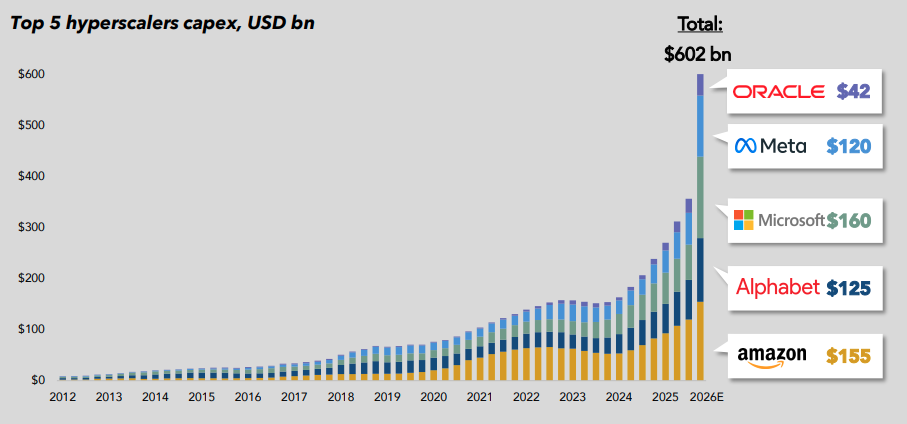
So why does this matter? Some may simply be appeased by the idea that companies have to spend money to make money, and this is true. The alarming piece of this puzzle for much of Wall Street though, is the sheer growth in spending. In 2022, Amazon, Alphabet, Meta, and Microsoft spent roughly $160 billion combined. In 2024, the number grew to $250 billion. Now we are staring down estimates of a trillion dollars in 2027 according to Bank of America and Evercore. The trajectory is stark. From 2022 to 2025 alone, the four companies more than doubled their combined spend in three years, then 2026 guidance represents another near doubling on top of that. Along with this outsized growth, big tech’s capex as a share of revenue has risen to its highest level in over a decade, a notable departure from the asset-light models that supported premium valuations for much of the past decade. The other staggering reality is that the line in the sand keeps getting redrawn. Coming into 2026, Wall Street was estimating that the big five hyperscalers, which includes Oracle, would spend roughly $600 billion, a 36% increase from 2025. And yet here we are a quarter in and that projection has hit approximately $725 billion, excluding Oracle.
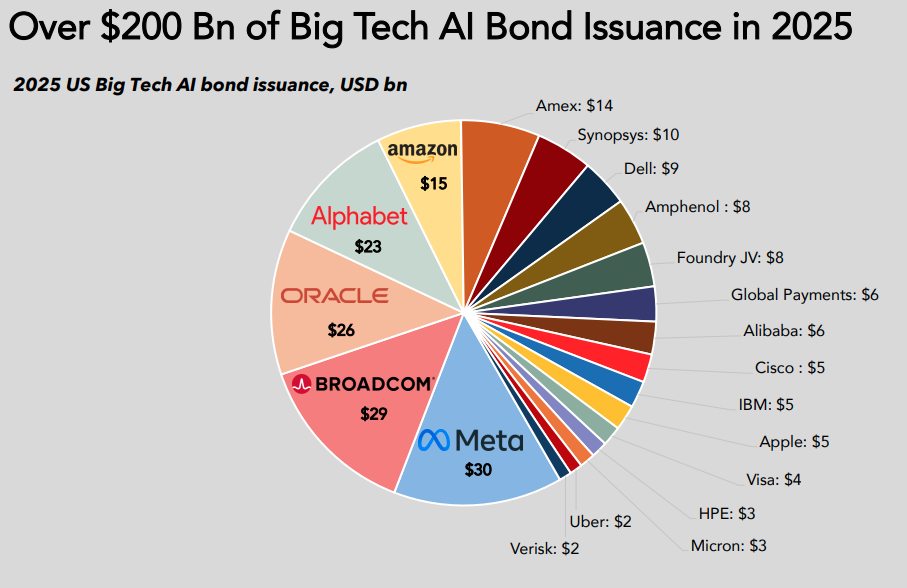
What makes this spending cycle particularly notable is how it is being financed. Much of the buildout is being funded through operating cash flow, but the sheer magnitude of the outlays has pushed these companies increasingly into debt markets to bridge the gap. In 2025, the five major hyperscalers issued roughly $121 billion in new debt, compared to $40 billion in 2020. In 2026 that figure is expected to more than double with Morgan Stanley estimating the group will need to issue upward of $400 billion in new bonds. Meta made the dynamic explicit when it completed a $25 billion bond sale on the same day it raised its capex ceiling, a signal that infrastructure spending is expected to outpace operating cash generation for the foreseeable future. Alphabet went further still, issuing a 100-year bond in February. When companies are borrowing against the next century to fund today’s data centers, the question of return on investment takes on a different dimension entirely.
The numbers emerging from big tech’s first quarter earnings cycle are difficult to contextualize through any ordinary corporate finance lens. Microsoft and Alphabet each guided that current 2026 expectations land at approximately $190 billion, a figure that exceeds the annual economic output of New Zealand. The stated rationale for these figures remains consistent across all four companies: data center expansion, GPU procurement, and the infrastructure required to train and serve increasingly capable AI models. What is not consistent is the evidence that the spending is working.
Bifurcation
This earnings cycle has made it clear that the market is not punishing AI spending broadly. Q1 2026 earnings drew a sharp contrast between the companies that can demonstrate external revenue validation and those that cannot. Investor sentiment this quarter hinged on a single variable, whether AI revenue is scaling fast enough to justify the outlays. And the answer to that question depends almost entirely on the structure of the business doing the spending. The distinction is structural, not cosmetic. Alphabet, Amazon, and Microsoft operate cloud platforms that sell AI infrastructure and services to third parties, which means customer demand provides a continuous, observable proof mechanism for their capital outlays. Meta occupies a fundamentally different position. Its data centers serve only its own properties, and the return on investment flows internally through advertising efficiency and user engagement rather than through enterprise contracts and cloud revenue. That payback path is harder to verify from the outside, and the market reacted accordingly.
By the Numbers
The numbers from the quarter bear out that distinction. Microsoft reported annualized AI revenue of $37 billion, up 123% year over year, with Azure growing 40% and topping the company’s own guidance. Alphabet posted Google Cloud revenue of $20 billion for the quarter, a 63% year-over-year increase that beat Wall Steet estimates by nearly $2 billion. Amazon’s AWS division grew 28% year-over-year to $37.6 billion in quarterly revenue, its fastest pace in fifteen quarters, with management citing robust enterprise demand for AI workloads as the primary driver. All three companies raised their full-year capex guidance and Google and Amazon saw shares jump higher on earnings. Meta beat on revenue, reporting $56.3 billion for the quarter and 33% year-over-year growth, it’s fastest since 2021, but raised its 2026 capex guidance to a range of $125 to $145 billion. It also suspended share buybacks for the second quarter. Shares fell more than 8.5% following the report. Alphabet and Amazon were rewarded without reservation. Microsoft, despite posting the strongest cloud metrics in its history, was penalized for the sheer magnitude of capex guidance. Meta fared worst of all, with neither the cloud revenue to validate the spend nor the restraint to temper the bill.
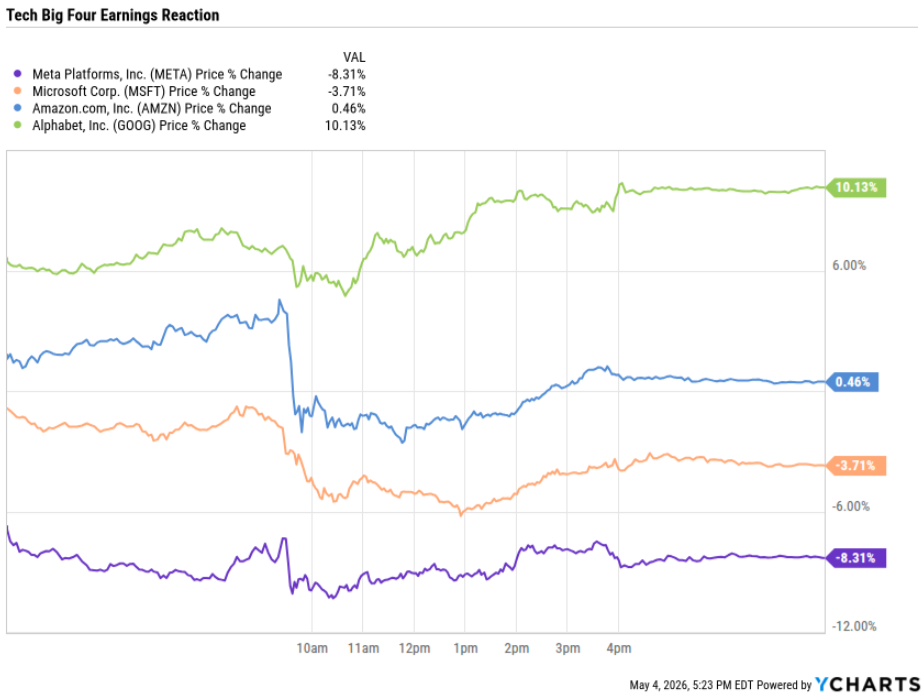
The market’s reaction to these results is being misread in some corners as a referendum on AI spending broadly. It is not. The hyperscalers that were rewarded this quarter are spending just as aggressively as Meta, and in some cases more. Alphabet raised its full-year capex guide to between $180 and $190 billion. Microsoft is guiding to $190 billion. Even Amazon has committed to roughly $200 billion for the year. The difference is not the magnitude of the investment but the legitimacy of the return. When enterprise customers are signing cloud contracts and those contracts are showing up in backlog figures and quarterly revenue, the market has a basis for valuing the spend. Alphabet’s Google Cloud backlog alone stood at $462 billion at the end of the quarter, with management indicating that just over half of that figure is expected to convert to revenue within the next 24 months. That is not a promise, it is a pipeline. What investors are demanding is not restraint. It is a validation mechanism that connects dollars deployed to dollars returned. Companies that can provide that connection are being valued accordingly. Companies that cannot are being asked to wait.
The New Baseline What this earnings cycle establishes is once again a new baseline expectation. The era in which AI spending itself was taken as evidence of strategic seriousness is giving way to a more disciplined framework. Markets are now asking a simpler question. Where is the revenue and is it sustainable? For companies with external cloud platforms, the answer is visible and growing. For companies whose AI investments are self-contained, the answer requires a degree of trust that quarterly earnings calls are increasingly ill-suited to provide. With combined hyperscaler capex projected to exceed $1 trillion in 2027, the stakes of the question will only rise. Investors who understand the structural difference between these two categories of AI spend are better positioned to navigate what comes next, whether that is continued multiple expansion for the cloud monetizers, or a prolonged period of scrutiny for those still asking the market to take their word for it.
Disclosure: I/we have no stock, option or similar derivative position in any of the companies mentioned, and no plans to initiate any such positions within the next 72 hours. I wrote this article myself, and it expresses my own opinions. I am not receiving compensation for it. I have no business relationship with any company whose stock is mentioned in this article.
Investment advice offered through Great Valley Advisor Group (GVA), a Registered Investment Advisor. I am solely an investment advisor representative of Great Valley Advisor Group, and not affiliated with LPL Financial. Any opinions or views expressed by me are not those of LPL Financial. This is not intended to be used as tax or legal advice. All performance referenced is historical and is no guarantee of future results. All indices are unmanaged and may not be invested into directly. Please consult a tax or legal professional for specific information and advice. LPL Compliance Tracking #1103947